Wednesday, April 4, 2012

Weekend trip to Concordia, Argentina

I went to stay in Concordia on the weekend of 16/17/18 March with Maggie, a friend who I met 2 years ago in Salvador, Brazil. Maggie is Argentinian but, like me, she loves Brazil and has been learning Portuguese - so we were like a pair of wannabe Brazilians speaking Portuguese together in Argentina, which her friends seemed to find quite funny!

Maggie, her nephew Santiago, and me on the Friday night shortly after I arrived in Concordia


Concordia is a small town of 240,000 people which is 6 hours North of Buenos Aires by bus. Going there was a great experience for me as it is completely off the tourist trail and gave me a taste of the 'real' Argentina. Maggie was an excellent hostess - she showed me all of the sites in the area and must have introduced me to over 50 people at various events over the course of the weekend, all of whom were very friendly.

Out with the girls from Maggie's Brazilian dance group


There are lots of fazendas (farms) surrounding the town, mostly growing citrus fruit I was told. The town itself still has dirt roads and I spotted the occasional horse and cart (mostly being used to collect rubbish.


Maggie's tortoise...She also had a dog, which seems very common in Argentina. 


Concordia is on the River Uruguay, which forms the border between Uruguay and Argentina. Me padding in the river:


 View of the river from the port


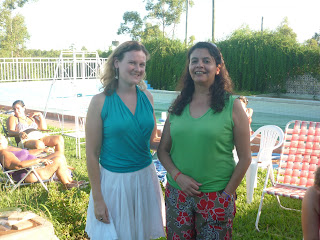
Maggie and me at her friend Marta's country retreat

Sailing club


On the Sunday night, the winning carnaval school did a final parade. We ate in a restaurant right in the middle of the action, so had a great view.


 Castle

Tuesday, April 3, 2012

Foray to Buenos Aires, Argentina

I went to Buenos Aires mainly to visit my friend Dylan who, after quitting his job, is living there for 5 months to learn Spanish and play tennis. 

Buenos Aires seems very European - it has wide tree-lined avenues, lots of cafes, museums, book shops and theatres. Dogs are also very popular and when you are walking you have to watch out for dog poo.

The food here is great. I've eaten a lot of lomo (filet steak) and ice cream - the dulce de leche (caramel) flavour in particular is really good (if you like sweet things!). 


Buenos Aires is easy to navigate as most of the streets are in a grid arrangement. I've walked around a lot as well as used the tube, buses and taxis. 

Palermo Woods after the rain...

Tulip art in Recoleta.


With Dylan at a monument in Recoleta


Obelisk in stormy weather.

View of the obelisk along Avenida Corrientes (very famous avenue with lots of theatres and book shops along it).

 San Telmo

Jardim Botanico

 Cemeterio  - where Evita is buried.

 Jesuit church

 Malvinas (Falklands) memorial in the Recoleta Cultural Centre.

 Cultural Centre in Recoleta
 Puerto Madero
 Caminito, La Boca


Church on Plaza Mayo in the centre of town.


March of the Madres, the mothers of adult children who went missing during the military dictatorship. The mother's march in the square every Thursday afternoon at 3.30pm demanding information on the whereabouts of their children.

Congresso Nacional


 Casa Rosada, where the government sits.


Pisco sours and dinner at Peru Deli - delicious!


Milonga on Scalabrini Ortiz, in Palermo

Thursday, March 15, 2012

Sao Paulo with my Dad

Spent a few days in Sao Paulo with my Dad - the first day at Monte Azul, the second sightseeing in the centre of Sao Paulo, and the third at the airport!

On the way to Peinha, one of the three 'nuclei' of Monte Azul...The other two are Monte Azul, which is a 10 minute walk away from Peinha, and Horizonte Azul, which is in the countryside outside Sao Paulo and takes about an hour and a half to get to.
Some of the children at Peinha. So cute!

With Douglas and Taty in Sao Paulo.


Coffee at the airport - Dad going to London, me going to Buenos Aires.


Monday, March 5, 2012

Northeast coast of Brazil

Spending a couple of weeks travelling with my Dad through five of the states in the Northeast of Brazil (Rio Grande do Norte, Pernambuco, Sergipe, Alagoas and Bahia). Brazil has 26 states in total, so plenty more to visit at some point! The Northeast is a very popular tourist destination as it has some of the best beaches in a Brazil and lots of the towns are known for their music and party atmosphere. 

Rio Grande do Norte 
Natal (Ponta Negra) 
Natal is famous for its beaches and sand dunes. We stayed in Ponta Negra, a lovely beach resort just outside the town. We found an English bar, Carumbar, so my Dad was happy (he likes talking but can't speak Portuguese!). Met lots of nice people, swam in the pool, walked around, went to the bar, ate 'prato feitos' (rice, beans and meat). We stayed an extra night so that we could hear Arni, the owner of the guesthouse where my Dad was staying, play in his band at Carumbar. One of the songs was an Irish tune which Arni's wife and I danced to - it was a lot of fun and everyone in the bar seemed to love it (not sure if it was the music or our dancing...). 

Praia da Pipa (and trip to Sibaume)
Praia da Pipa is a very cool place - it's small, with one main cobbled street, lots of little shops, restaurants and bars. We stayed in a great hostel which was spacious and had a swimming pool. We met lots of people there and I spent one day with some new Brazilian friends going to the beach at Sibaume and a night out at a forro club. So much fun! I want to go again...

Pernambuco
Recife 
We spent 3 nights based in Recife, with one day in Olinda and one day in Porto de Galinhas. Recife has lots of canals, but we learned that canals in Brazil are not the same as in the UK - they're generally sewage canals! 

Olinda
Olinda is 'beautiful' in Portuguese and the town really is beautiful, even if not all that well maintained in places. It was my Dad's 60th birthday when we went to Olinda and we had a nice leisurely day walking around, drinking coffee and eating cake at periodic intervals! 

Porto de Galinhas
Known as one of the nicest beaches in the Northeast of Brazil. The water is amazingly clear, the beach is beautiful and the town is nice to walk around, a bit like Pipa. There are lots of crazy looking chickens dotted about (galinha = chicken). The name of the port actually comes from the ships which smuggled in slaves after the slave trade was banned in Brazil - the slaves were hidden by crates of chickens. Pretty grim.

Alagoas
Maceio 
Maceio is the capital of Alagoas state and I thought it would be good to stop here on our journey Southwards towards Salvador. The beach is a bit like the one in Santos, with a cycle track running along it and then the road next to that. One thing of note was the ice cream cafe Sorvetaria Bali - you can help yourself to whatever ice cream and topping you want and then you pay by the weight of it. Great stuff! 

Penedo 
Lovely colonial town, full of interesting buildings. It's very easy to walk around the historical part of town, which is by the Rio Sao Francisco - the third largest river in Brazil. We stayed in the Pousada Colonial, a converted colonial mansion house, which I loved.  

Sergipe
Aracaju 
Capital of Sergipe and another stopping place on our way to Salvador. The state government building was impressive, looking out onto the main square. We stayed in the Centro which is quite a way from the beaches. We were a bit beached out by this point, so decided not to make the trip to see the beaches. Went instead to the markets just North of the centre - there's a local craft market and a food market. 

Bahia
Salvador 
Last stop - Salvador! Salvador is a great city, with the Pelourinho historical centre, lots of churches, music and artwork, and beaches nearby just outside the city centre. The one slightly annoying thing is that tourists get hassled all the time by people wanting money - usually they try to do something for the money eg. one guy went off to find some ice for me when the bar I was in had run out and then proceeded to try to rip us off by demanding ridiculous amounts of money for the ice...You live and learn! 
It was a whirlwind couple of weeks and we packed lots in, with great variety in the types of places we visited, where we stayed, what we ate and who we met. A really good experience!


Friday, March 2, 2012

Carnaval break in Santos, Sao Vicente, Casqueiro and Cubatao

Santos and Sao Vicente are towns next to each other on the coast - they each have a section of the same stretch of beach. Sao Vicente (where I spent New Year with my mum) is the oldest town in Brazil, founded by the Portuguese in 1532. A bit further inland you get to Casquerio, a small town where Adriano's friend Douglas lives, and further still you reach Cubatao, where Adriano, his sister and mother live. Cubatao is a very industrial town with lots of factories, gas bottling plants etc and it used to be known for being polluted but it's now much cleaner (luckily!). 

Santos and Sao Vicente - the red monument jutting out into the sea is the dividing line
My Dad arrived in Sao Paulo early in the morning on Sunday 19 February and I met him at the airport - I didn't get much sleep as I arrived back from Carnaval celebrations in SP at 5am and had to leave Dona Lindalva's house at 7am! We got the bus straight from the airport to Santos to stay with Adriano's friend Douglas for a couple of days. Douglas picked us up from the rodoviaria (bus station) and we went to his house in Casqueiro for lunch (cannelloni made with pancake rather than pasta). We spent the afternoon with Douglas and his wife Tati in Sao Vicente where there were people were paragliding - Douglas knew quite a few of the people working there as he used to have his own paraglide.


We had pizza with egg and cheese on top (common in Brazil) for dinner at Douglas's house when Adriano came over after he finished work. Douglas had the day off work the next day for Carnaval (though Adriano and Tati had to work) so we spent the day with him on the beach at Santos. It took us about half an hour to park - Santos is a popular place during holiday times.  We went up to the independence monument (Brazil was declared independent from Portugal in 1822) and on the bonde (tram) around the historical parts of Santos. 


We also tried aqua do coco (coconut milk drunk straight from the coconut) and caldo da cana (sugarcane juice). Adriano came over in the evening and we watched the Carnaval celebrations on TV and chatted. Adriano had the day off the next day and we went to visit his mum, sister and nephew in Cubatao for an hour or so before we drove to the airport in Adriano's new car.